Maximizing Sales: The Definition & Advantages to Multichannel Selling
Introduction to multichannel sales
Engaging with customers on multiple channels has become increasingly important to constantly present your product to potential customers. According to several online studies, it takes an average of 8 different touchpoints with the customer to make a sale. Reaching these 8 touchpoints is difficult, especially if your company is only using the offline store as the only channel. Multichannel sales, on the other hand, entails utilizing several marketing channels to reach your customer segments.
What is multichannel selling?
Multichannel sales refer to a business approach that involves selling products or services through multiple channels simultaneously. These channels can include physical stores, online marketplaces, online retailers and your own online shop. This strategy aims to provide customers with a seamless and consistent experience across different channels, allowing them to interact with the brand and make purchases through their preferred method. Thus, you give more control to the customer and allow them to choose how they want to engage with your brand.
By adopting a multichannel sales strategy, companies can expand their reach and accessibility to customers, strengthen brand presence and ultimately increase revenue potential. Moreover, multichannel sales enable your business to adapt to rapidly shifting market dynamics, tap into new customer segments and address emerging trends effectively.
In the following section, we will dive deeper into the advantages of implementing a multichannel sales strategy and provide insights on what are the challenges.
Benefits of multichannel sales
Selling on multiple channels can be a challenge for any business at first, but the advantages clearly outweigh the challenges.
1. Increased reach and accessibility to customers
Everybody has preferences, which channel they prefer for making purchases. By utilizing multiple sales channels, businesses can cater to the different channel preferences of their customers. This means that no matter where a customer prefers to shop, whether it's in-store, online, or through mobile apps, the business can meet their needs and provide a seamless shopping experience. This increased reach and accessibility to customers not only expands the potential customer base but also allows businesses to capture sales that may have otherwise been lost if they were limited to a single sales channel.
2. More opportunities for brand awareness and embracing the customer journey
At this point, we are coming back to the topic of touchpoints mentioned earlier. A multichannel strategy provides firms with more opportunities to contact customers to gain more sales than a single-channel strategy. As the average consumer needs 8 touchpoints before making a purchase decision, having multiple channels allows businesses to create more touchpoints and engage with customers at different stages of their purchasing journey. Being active in several stages of the customer journey enables you to build brand awareness, increase customer engagement, and create a consistent brand experience across multiple touchpoints. Brand awareness is crucial for businesses to stand out in a competitive market and attract new customers, as well as foster loyalty among existing customers.
3. Improving customer-service, satisfaction and trust
Both advantages mentioned above also contribute to improving customer service, satisfaction, and trust. By providing customers with options to shop through different channels, businesses can offer a more convenient and personalized shopping experience, which ultimately leads to higher customer satisfaction. Furthermore, studies have shown that multichannel shoppers, who engage with a business through multiple channels, are often the most valuable customers. They tend to spend more than customers who only use one channel, making them a valuable segment for businesses to target. Finally, a multichannel strategy allows businesses to build stronger customer relationships.
4. Improved revenue potential due to bigger market
The pressure from competitors forces businesses to adopt a multichannel strategy to extend their touchpoints and always be present where the consumer is. One of the key advantages of implementing a multichannel sales strategy is the potential to increase revenue through market penetration. By reaching a broader brand awareness and building strong customer relationships, businesses can expand their market reach and attract more customers.
Besides that, the diversification with multiple sales channels significantly reduces the risk of financial trouble. If the revenue of one channel breaks down, you still have several more to keep your business afloat.
Challenges and disadvantages of multichannel sales
Although the advantage soutweigh the challenges you still have to consider some aspects which can causea lot of extra workload and impact the success of your multichannel sales strategy. In the following, we will present you with some of the most important ones.
1. Managing your data efficiently
If you are selling on multiple channels, you will have a lot of data points you need to provide to the different channels. They often have particular data requirements that differ from each other demanding you to have several excel sheets for the channels. Now if one product dimension changes or you notice an error you must change it manually for each channel. This produces an enormous extra workload which prevents you from selling to other channels.
2. Data exchange with partners
The different data requirements of the online retailers brings another disadvantage. As one of them needs you to hand in the data via excel sheets, the other one requires an API integration and the other one has an own seller portal. That means you must send your product information within several different formats, causing more manual workload and nerve-wrecking breakdowns. In order to prevent any more breakdowns, it would be beneficial to manage the data from one central place.
3. Analyzing your sales channels
If you want to improve your sales processes and generally number of sales, you need to learn from your previous mistakes. This requires you to analyze your active sales channels for any interesting information, like products gone offline, price drops or reviews, however analyzing them all on your own is especially ineffective.
You need to manually crawl each of them for the different categories and later summarize the gathered information, resulting in a timely and nerve-wracking process. To fully exploit the value of the data you need a tool that can collect and analyze the data to send it back to you in a compromised and meaningful way. More on that topic in a later blog post.
4. Maintaining brand consistency
To market your brand appropriately you need to make sure that you follow a few specific guidelines. The appearance of your brand has to be consistent throughout all your sales channels. That contains for example the right color scheme, the same approach for naming products, as well as for product descriptions and pictures. Aligning them is simple work but timely and easy to outsource by using a system which facilitates managing your product information. Thus, it enables you to focus on more important tasks.
How shopvibes helps you win your multichannel game
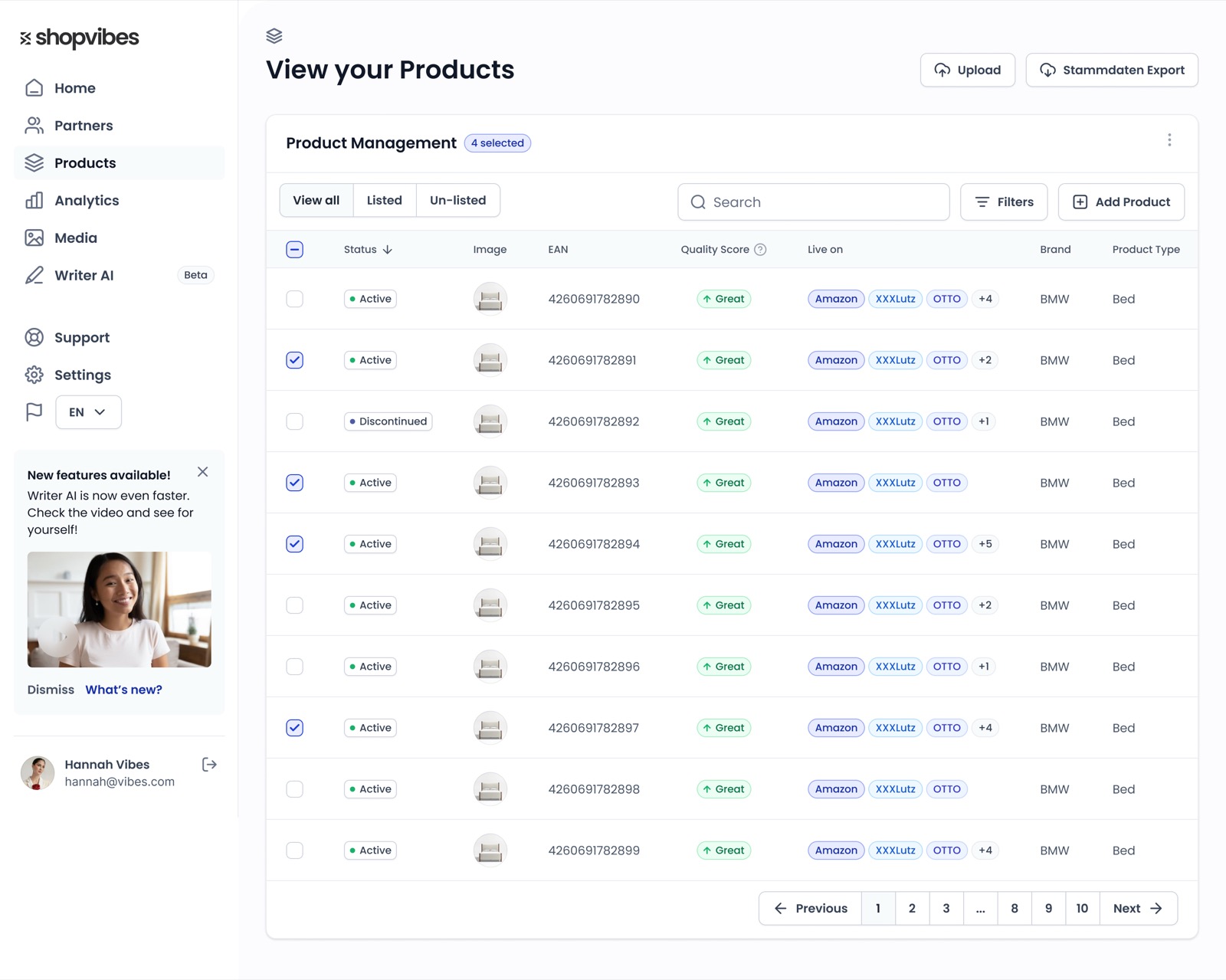
Tackling the challenges named above gives you the opportunity to exploit all the advantages of multichannel sales. Therefore, shopvibes developed a centralized solution to manage, optimize and analyze your multichannel sales. But how can shopvibes exactly help you?
One of the standout aspects of shopvibes is its centralized approach. All your product details, along with the media, can be organized in one digital hub. This doesn’t just make life easier for your sales team, but also ensures that all teams and stakeholders are aligned, reducing any potential miscommunication, outdated data or errors.
A feature worth mentioning is its AI-driven content assistance. If crafting product descriptions isn’t your strong suit, or you're just looking to save time, shopvibes offers an excellent way to generate descriptions based on your existing data.
To optimize your data for all your different online retailers, shopvibes provides guidance and quality checks to ensure everything aligns with the platform standards. Our Quality Score helps you to make sure you never miss any attribute by highlighting products where attributes are missing. Thus, you can make sure you have everything in place before you list your products. The process of sending your data to the online retailers is straightforward, minimizing manual tweaks.
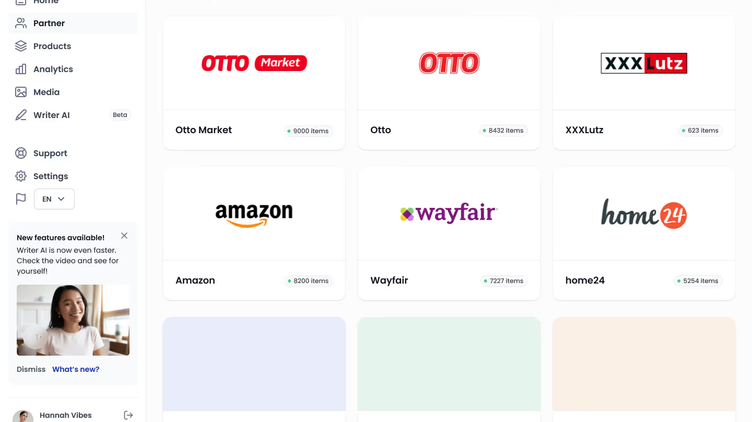
A significant plus is the platform's adaptability as you aren't limited to any specific online retailers. With shopvibes, you can set up your product details and use them across multiple platforms or partners. It’s a one-time effort with a multi-platform reach.
Case Studies of successful multichannel selling
There are many successful companies which implemented multichannel in the past few years with the help of shopvibes. Let’s look at Hanse Home, one of our customers in the home & living segment who sell their products on retailers like Wayfair, Amazon and OTTO with great success.

Hanse Home
We partnered up with Hanse Home 1,5 years ago. Before they partnered up with us, Hanse Home stored its product data in its ERP system. However, retail partners' requirements for product data quality are increasing. Adding and optimizing product data in the current system is tedious or not even possible to the extent required. This leads to manual and repetitive work to add all missing data points for each retail partner, one by one. This results in inconsistent product presentation and makes it difficult to optimize product data for retail partners.
Hanse Home uses shopvibes to manage, optimize and distribute its product data and images. This enables consistent and efficient optimization of all product data and reduces effort to a minimum. All data is managed and optimized in the shopvibes platform and can be distributed directly to all retail partners. This enables better data quality across all partners and reduces the effort for Hanse Home.
Conclusion
Over the course of this article, you learned why multichannel sales is important to stay relevant and win over your competition. However, a proven system, which enables your to mitigate the challenges is of extreme importance. Without that your costs for selling multichannel would almost completely churn your extra revenue.
shopvibes offers the perfect solution for the ambitious multichannel strategies. It takes the work from you and gives you the chance to make more sales.
If you are interested in shopvibes, click here to book a demo and learn how exactly we can help your level up your multichannel game.
About the author

Author
Tim Hoffmann
Chief Product Officer, shopvibes
Tim Hoffmann is a seasoned eCommerce technology leader in product data management, marketplace integrations, and workflow automation. As Head of Product at shopvibes, he combines hands-on technical expertise with a deep understanding of merchant needs, having worked with leading brands to streamline complex multi-channel operations. Tim shares actionable strategies grounded in real-world results to help businesses improve product visibility and accelerate sales growth.